Translate

Wednesday, July 2, 2014

The Feast of St. Peter and Paul


We had an extremely busy day on Sunday, June 29, because of the very important feast day of Sts.Peter and Paul. The Mass at St. Francis Church was 90 minutes long, a little longer than normal. The church was packed with people. This is not unusual; the weekday Mass is usually packed as well. There was a procession going into church with St. Peter and St. Paul each on a large platform, carried by many men. A band was playing as they entered the church. At the end of Mass, the procession led to the Port of Paita where many groups of people gathered in their decorated fishing boats. St. Peter and St. Paul led a procession of many boats in the Port of Paita. (This is the 3rd largest port in Peru.)

We were invited by a friend of the sisters. At least 60 people were on the fishing boat where we were guest. In fact, one of the guests was running for Mayor. We were sitting in a boat, on the top of this big fishing boat. It took a while to finally get on the way. We sat in the boat for at least 45 minutes until we joined the procession.

Our host served food and drink on the boat and we ate a traditional Peruvian meal of rice and chicken. Once our boat got near St. Peter and St. Paul, a wreath of beautiful flowers were thrown into the water in commemoration of the fishermen who lost their lives over the past year. 


The whole procession took about three hours. It was a rich experience we'll never forget.


Wreath of Flowers


St. Peter Carried Into Church at Beginning of Mass


St. Paul Carried Out at End of Mass


Fishing Boats Going Out in Harbor to Celebrate this Feast Day


We were a guest on this boat!


Here's Our Boat!


Boat similar to the one we were in.


Family of our Host

Sister Matilde

Dr. Peggy (There's Deb in the reflection!)


Sunday, June 29, 2014

Fabiana

I reported on Fabiana in 2013. If you look at the blogs from last year, you'll see the information about this very intelligent 7-year-old girl who has Epdermolysis bullosa. This is an inherited connective tissue disease causing blisters in the skin and mucosal membranes. It happens in 1 out of 50,000.

Fabiana lives five minutes from St. Clare School. Both of the parent work. Here in Peru, wages are very low. They can modestly provide for their family. However, Fabiana requires lots of medications, vitamins, nutritional drinks, etc. When we saw Fabiana, we provided her with a four-month supply of a nutritional drink., to be used only once a day. If she has to use it twice a day, it is only a two month supply. We also provided her with a short supply of vitamins as well.

Our committee will be talking more about Fabiana when we return. We'll have to see how we can help her.

Here are a few pictures of Fabiana.

Reported by Deb Passino


Saturday, June 28, 2014

Difficulties in the Kitchen

As the chief cook and bottle washer, I've enjoyed cooking meals. I tried my best to keep the group well-fed. It is somewhat difficult working in the kitchen here in Peru. There is no hot water at the sisters. To wash the dishes, one must have one washbasin with soap water and the other with bleach water to disinfect them.

Also, to wash vegetables, one must use soap for the fruit and skinned vegetables and scrub them with a green scrub pad. Then one must rinse the vegetables in an iodine bath. It is a lot of work.

Shopping is difficult because one must take the motokar to the store and take it back home with all of the groceries. It is not very convenient.

Everything has a different taste here in Peru. It's a good different. There are fewer products to buy, except for soft drinks. Coke is most popular here. Also, did you know that the recipe for Coke here in Peru is different from the recipe in the USA? I think it contains less sugar and it comes in 3L jug.

I wanted to make Muesli chocolate chip cookies and they don't sell brown sugar or chocolate chips.  However, to make up for it, we bought two beautiful cakes, a mousse cake and a cheesecake. Their bakery and breads are wonderful. I haven't eaten this much bread in years!

The vegetables and fruits are fresh. The chicken is really good because it's fresh as well.

Submitted by Deb

Before


After


Wednesday, June 25, 2014

La Clinica - Miercoles

It's Wednesday.  The first time this trip where we have had a larger amount if time to sit and reflect on the last few days.  No matter how much preparation, the first day usually feels like a "fly by the seat of your pants" experience.  I personally was thrown a hurdle to overcome on the first day.  The women on this mission trip are a group of the most wonderful people I know.  The problem was analyzed, trouble shot, and solved in minutes.  The rest of the day was not without additional stresses and obstacles, but they were met with the same fortitude by this group.  The second day has gone much more smoothly and with a great deal less stress.  I thank my prayer sponsor for that:)


The patients who present to the clinic are grateful we have come.  We have treated a number of people for malnutrition and parasites.  A few people have been newly diagnosed with diabetes and high blood pressure.  Even providing a small supply of Tylenol has been met with much gratitude.

Charlie and I spent this afternoon at a child screening clinic.  They were tested for a number of parasites and anemia (low red blood cell counts and usually iron deficiency). There is a lot of it down here.

We met Fabiana and her mother this afternoon.  She is a typical child with a medical condition, but lives in a less than ideal environment.  She likes recess, and likes to read--mainly fantasy books.  She has thinning hair and a number of lesions on her skin.  The vitamins we are bringing to her should help, but are probably not enough for the demand her medical condition places on her body.  Despite her condition, she is happy and go lucky.  And very polite!  :)

The roads and neighborhoods are dusty and dirty.  Despite the clouds, it does not rain much here.  Last winter, it rained seven times.  Not too many times this year, so far.  They have garbage collection, but the streets and open area are riddled with litter.  The housing here is very modest.  There are no water treatment plants, so we filter our drinking water and even use our water bottles for brushing our teeth.  The laundry is done in buckets and rinsed the same way and hung to dry.  Usually, the clothing is dry by the evening.    

The work is hard.  The company is great.  Having fun and making light of moments when possible.  The sisters are awesome.  Another group of fun loving women who can solve problems and bust down walls with little to no effort.

I would have to say we have all worked very hard so far.  Despite fatigue, we show no signs of letting up.  Kudos to Catherine for putting up with my lack of Spanish.  She has been my right hand for communicating with our patients.

Need to get food and start getting ready for tomorrow.  More to come!

Peggy Stickney, MD

Tuesday, June 24, 2014

First Day of Clinic - Tuesday Afternoon in PRONOEI


There were over 50 patients seen at the clinic in PRONOEI this afternoon. Most of the medicines, eye glasses, and various supplies, had to be placed in suitcases and transported via a motorkar. Once moved, it had to be set up again in the new location.


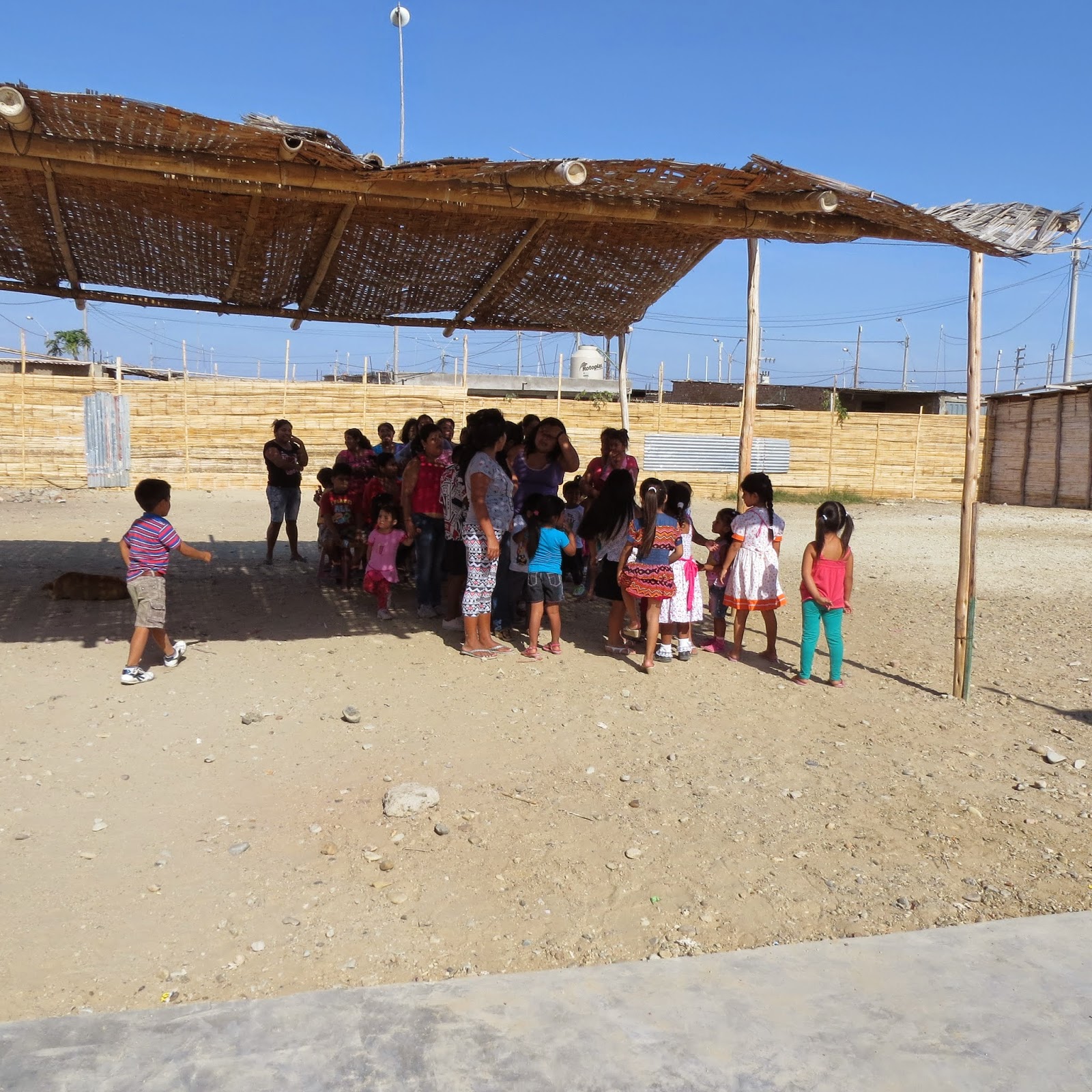
This area is a very poor area of town. The people do not have a title or deed to the home they have built in this area. In some areas of Paita, people have invaded the public lands and established neighborhoods; the government eventually gave them a title.

Some of the homes have electricity and some don't. They don't have inside plumbing which means they don't have running water. There is a large cistern and the city delivers water to it. It has very limited capacity so if cistern empties quickly, you're out until water is delivered again. It is city water and the water is filtered. However, it's not drinkable.

Without plumbing, the homeowner must dig a hole around their home and place a large tank, like a septic tank, and empty water and excrement  into this tank. Once the tank is full, it is filled with ash and another hole must be dug and placed in the ground. Those who can't afford a tank dump the excrement somewhere. In some areas, there was a nasty smell.


There is no garbage pickup in this area so one will see bags and garbage blowing in the wind.


No Road and Sand Everywhere

More Homes


This is the PRONOEI Public School run by the School Sister.
 Here's how we setup the PRONOEI clinic. There are two preschool buildings. The triage were in one building and the doctors were in the other.

Eye Glasses Donated by St. Paul parishioners and Anthem BCBS

Shelley setting up Pharmacy at PRONOEI

The Peruvian Public Health collaborated with our team to test children for anemia and they plan on following up with the families to provide assistance.

Peruvian Public Health Testing for Anemia


Families waiting for a doctor

More Waiting

Triage Area


Waiting for Patients

Taking Temperature
Miranda Translating for Nancy

Ellen Working a Family

Public Health Technician Getting Blood Sample

Dr. Peggy and Catherine

Dogs Everywhere

Dr. Peggy and Catherine Talking With Another Patient


Charlie Checking the Ears of a Child


Another Patient...

...And Another


Sister Paula Fitting Glasses

Ellen in Triage with a Patient


LOOK MOM! I CAN SEE!

Dr. Peggy and Catherine With Patients